The digital layer for design-led businesses.

I’m Christopher Schafrath. I design and engineer websites, client journeys and intelligent tools for businesses where taste and service are part of the product, from the first thing a client sees to the systems that have to hold up behind it.

I care about the places in a business no one sees: the booking, the inquiry or the follow-up that quietly stops working, and what that costs.

Take the 4-minute automation scorecardhello@studioschafrath.comSee the work

Practice

The digital side of a business should meet the same standard as everything else it makes. I work on three parts of it, and they’re strongest when they’re designed together.

  1. Digital experience

    Websites and interfaces that explain what you do with the care you put into doing it. Structure, writing, interaction and build, handled as one piece of work.

    Websites · Interaction design · Editorial structure

  2. Client journeys

    The stretch between someone’s first interest and your first real conversation: how they inquire, what they’re asked, how soon they hear back and who picks it up. Designed so it still feels like your business once it leaves the website.

    Inquiry and booking · Intake · Handoffs

  3. Intelligent tools

    Internal tools and AI-assisted systems for the work behind the experience: sorting what comes in, preparing briefs, keeping decisions and their reasons in one place. They take friction out of the day without taking people out of the judgment calls.

    Internal tools · AI workflows · Operational systems

Keep-Running

Fixed prices for the automations you already run.

Zapier, Make, n8n and Google Workspace. When a zap stops, a form stops landing or a follow-up never goes out, I find out why, fix it and make sure you hear about it next time before a client does.

  1. Fix One

    $450

    One automation that is broken or fragile, delivered in 5 business days from access. Cause found and fixed, tested with sample data, a failure alert to a shared inbox and a one-page runbook.

    One workflow · 5 business days · 14-day re-fix

  2. Audit

    $1,250

    Up to 15 automations across Zapier, Make, n8n and Apps Script, delivered in 10 business days from access. A register you keep, who owns every login, a risk ranking with a fixed price for each fix, and failure alerts for everything in scope.

    Up to 15 automations · Register · Ranked fix list

  3. Care

    $350 / month

    Up to 10 automations ($600 a month for up to 25). A weekly read of every run history, a broken flow fixed within 2 business days, one hour a month of small changes and a one-page monthly report. Month to month, cancel by email.

    Weekly checks · 2-day fixes · Month to month

I work through member access you control and can remove at any time, never your passwords. Half to start, half on delivery for Fix One and the Audit. Not sure where you stand? Take the scorecard or readhow Keep-Running works.

Selected work

Client Intake OperatorSelf-initiated · 2026

When the brief disagrees with itself.

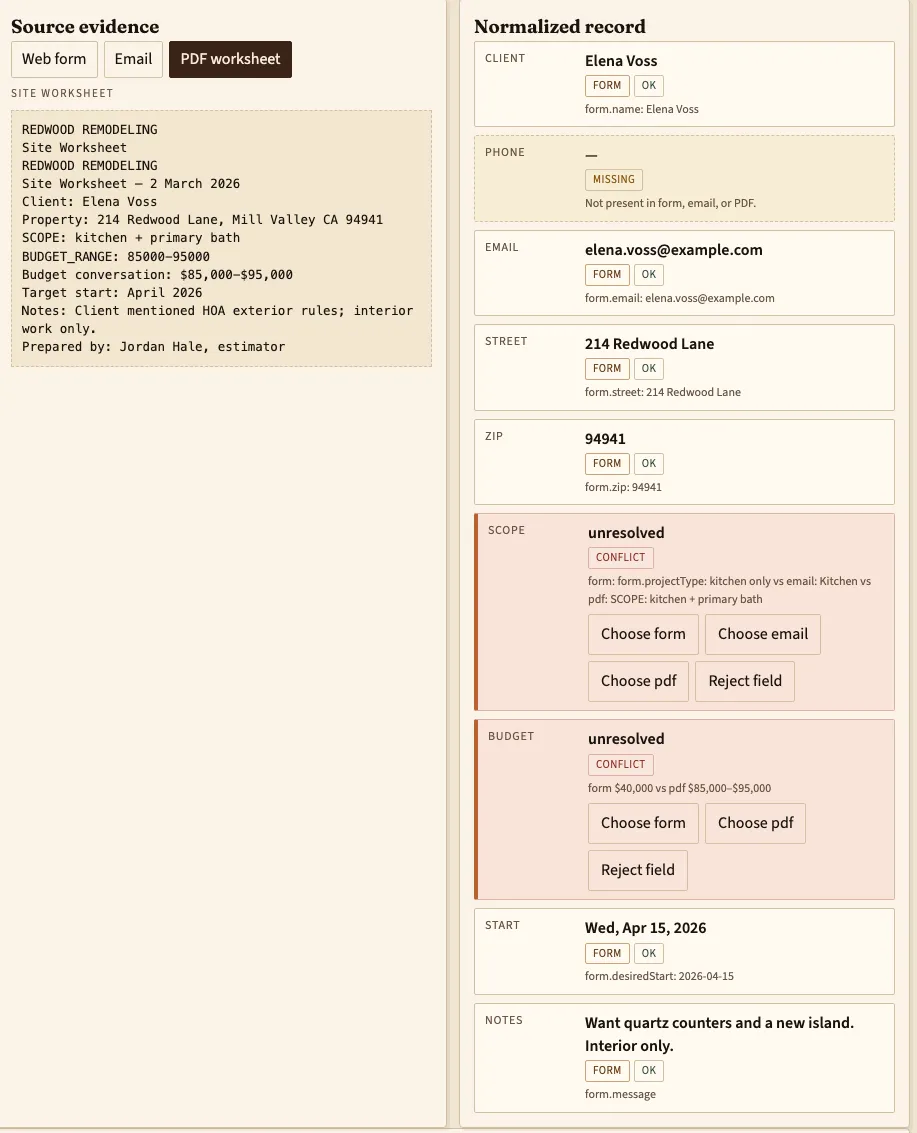
Projects tend to arrive in pieces. Here a kitchen remodel shows up three times, as a web form, a follow-up email and a site worksheet, and the three don’t agree. Client Intake Operator reads all of them, builds a single record and keeps every disagreement visible until a person settles it.

Elena Voss, kitchen remodelSynthetic test record · three sources, one record
FieldWeb formEmailSite worksheetRecord
ScopeKitchen onlyKitchen and hall bathKitchen and primary bathHeldThree versions of the job
Budget$40,000Not stated$85,000–95,000HeldSources disagree
PhoneNot stated“I will send a mobile number later.”Not statedMissingApproval locked until it arrives
StartApril 15, 2026Mid-AprilApril 2026April 15, 2026Agreed
HOA contactNot statedNot stated“Client mentioned HOA exterior rules”Dana Ruiz, 415-555-0199DroppedGuessed at 91% confidence. No source contains it.
From the demonstration’s test fixtures. The client, addresses and phone numbers are invented.
Part of the reviewer’s screen for the Voss kitchen packet. The site worksheet sits beside the normalized record, which marks the phone as missing and flags conflicts on scope and budget with a choice of source for each.
The reviewer’s screen, cropped. Approval stays disabled while the phone is missing and scope and budget are unresolved.

Decisions that shaped it

  1. Disagreement is information.

    When the form says $40,000 and the worksheet says $85,000 to $95,000, quietly picking one is the easy mistake. The record keeps both, each tied to its source, and asks.

  2. Nothing invented gets through.

    The extractor was 91% confident about an HOA contact nobody had provided. If no source backs a value, it doesn’t reach the record.

  3. A person approves.

    The software prepares the record. Making it the job file is a human decision, and approval stays locked until that decision can be made properly.

On its synthetic test set it got 33 of 33 fields right, caught all three planted conflicts and both missing fields, and kept no invented values. It runs locally on test records and hasn’t been connected to a live inbox or used on a real client’s work.

The records belong to a residential remodeler. Private events, design commissions and development inquiries can begin the same way: in pieces, from more than one person.

Role
Design, system logic and build
Status
Tested on synthetic records

Revenue RescueSelf-initiated · 2026

When the furnace goes out at 2am.

After-hours emergency and quote requests for an independent HVAC shop die in a shared inbox. Revenue Rescue reads the inbound message, classifies it inside a closed schema, acknowledges it exactly once, routes it to the after-hours dispatcher, and puts it on an SLA clock a human can resolve or escalate.
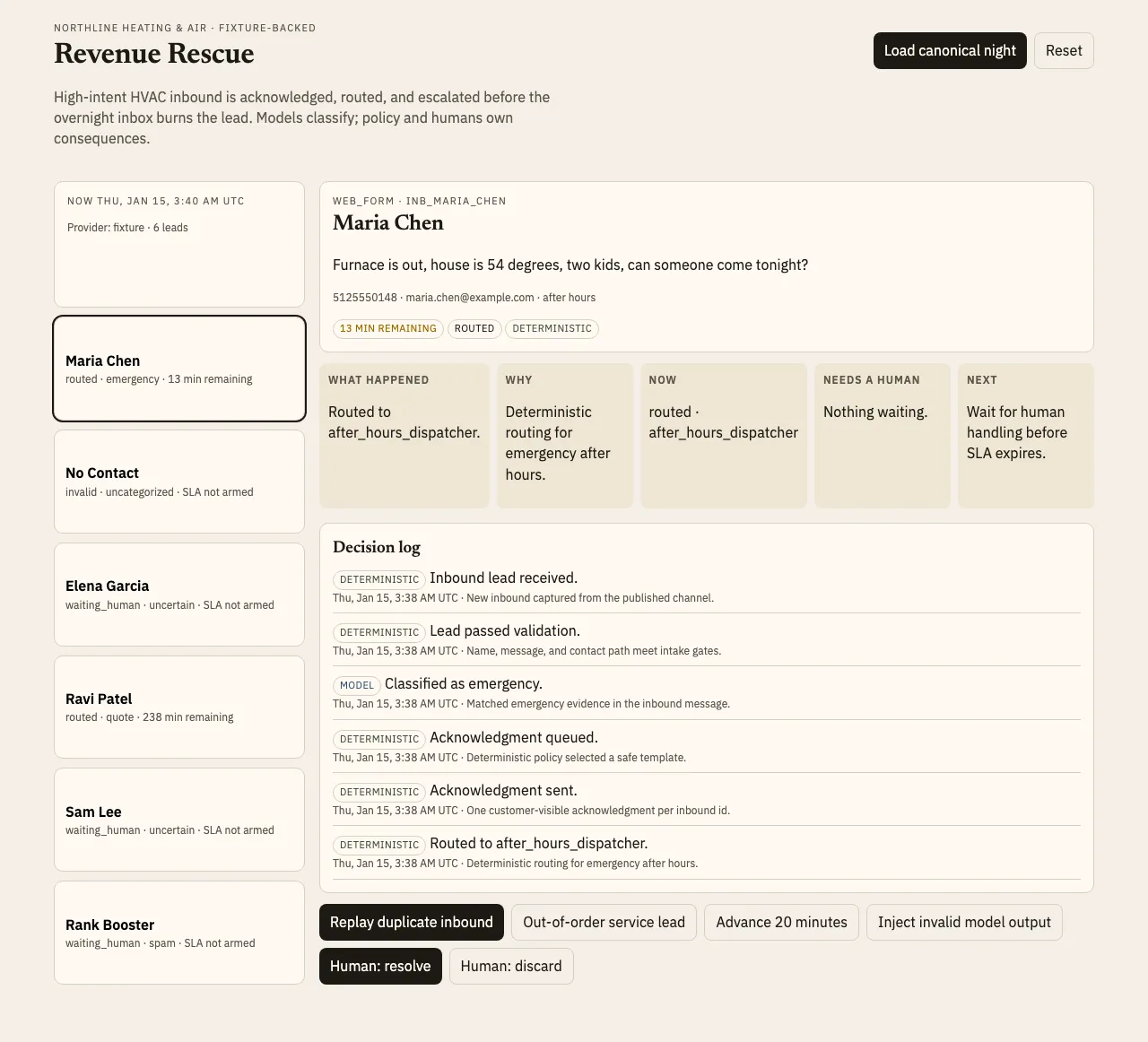
Operator console for the synthetic tenant Northline Heating & Air. Maria Chen's after-hours furnace emergency is routed, with a decision log separating deterministic policy from model classification and a remaining SLA window.
Cropped to the canonical after-hours emergency. The tenant is labeled fixture-backed in the console. Full interface in the repository.

On 16 labeled fixtures it matched all 16, and the no-second-acknowledgment rule held under fault injection. It never invents an ETA, and replay can’t send a second customer-visible message. It runs locally on test records. No live SMS provider is connected and no real shop uses it yet.

Role
Design, policy and build
Status
Tested on synthetic records

Owner IntelligenceSelf-initiated · 2026

The morning brief, with receipts.

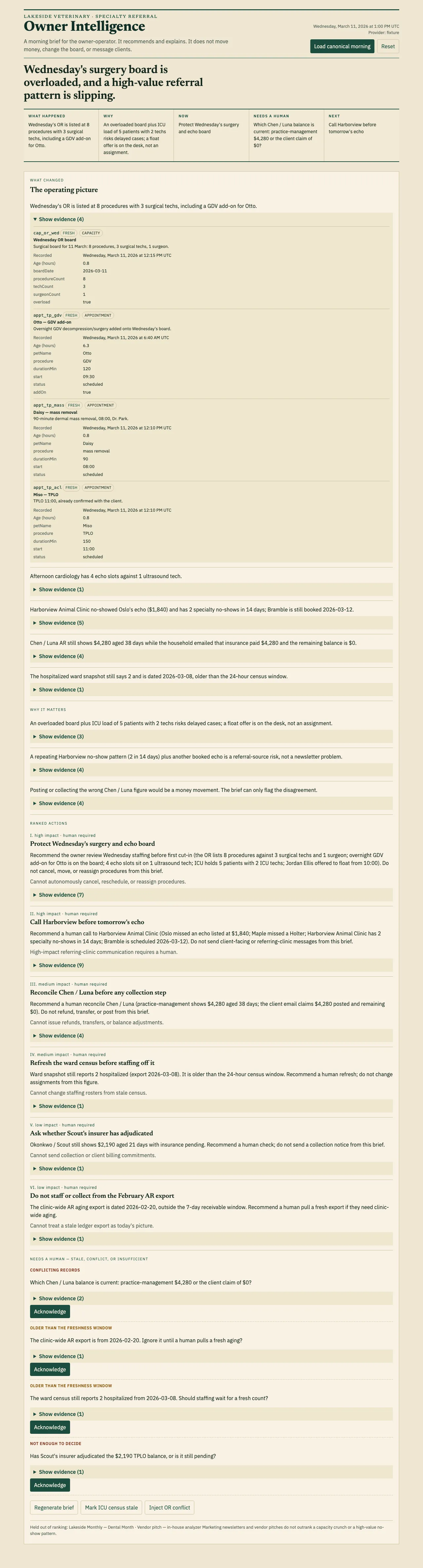
A specialty clinic’s operating board, referrals, and receivables disagree, and the important changes are buried. Owner Intelligence turns the Wednesday records into a ranked morning brief (what changed, why it matters, what to do), with every recommendation carrying its record ids and anything stale or conflicting flagged for a human.

Morning brief for the synthetic tenant Lakeside Veterinary. The header states that Wednesday's surgery board is overloaded and a high-value referral pattern is slipping, with evidence drawers and owned actions beneath.
Cropped to the canonical Wednesday brief. The tenant is synthetic. Full brief in the repository.

On 3 labeled scenarios it matched all 3, with zero unsupported numerical claims. It can’t move money, change the schedule, or message clients. It recommends; the owner decides. Tested on synthetic records; no live practice system is connected.

Role
Design, policy and build
Status
Tested on synthetic records

HELMOwn product · In progress

The studio’s own operating system.

It brings notes, tasks, decisions and the automated work around them into one local workspace, where every change is recorded and can be undone. I set the product direction and the system design; AI coding agents handle much of the implementation under my direction. A public walkthrough is in preparation.

About

How something looks, and how it behaves.

Most of my working life has been in operations, not on screens, in work where small misses cost real money. That is where I learned that the trouble in a business is usually in the places no one sees.

My background runs through operations, technology and design, with years spent living and working in different parts of the world. That mix taught me to watch both: how a business explains itself, how a client moves through it, where information gets lost between people, and where a well-made system can take out friction without flattening the human part.

Studio Schafrath is where I bring those disciplines together. It’s independent by design, so the person who understands your business is the one designing and engineering the result. More and more of that work involves AI, in the tools I build and in how I build them, and it has changed what one person can take on.

Based
Seattle, working internationally
Elsewhere
LinkedIn, GitHub

Working together

Start with one project, scoped in writing.

A first engagement is one defined piece of work, a website, a client journey or a tool, with an agreed end and something real at the finish. Ongoing work can follow as a separate agreement if there’s a real need for it.

  1. A short note

    Send a link to your business and a few sentences about what you want to make or change. You don’t need a brief. I’ll reply with my read on the fit and the questions that would shape the scope.

  2. A written scope

    What we’re making, what it has to do, how we’ll judge it, what it depends on and what it costs. Scope and fee agreed in writing before work begins.

  3. Design and engineering

    Writing, interface and system developed together. You review working versions you can actually use, and you deal with me directly throughout.

  4. Handover

    The finished work, live or ready to launch, with its source files and a plain explanation of how it works. Connecting it to your inbox, booking system or CRM is written into the scope when the project needs it.

Contact

Tell me what is broken, or what you are building.

Send three things: a link to your business, the tools involved (Zapier, Make, n8n, Google Workspace, your CRM) and what is going wrong or what you want to make. A few sentences is enough. No call needed. I read every message myself and reply with my read on the fit and what it would cost.

LinkedIn